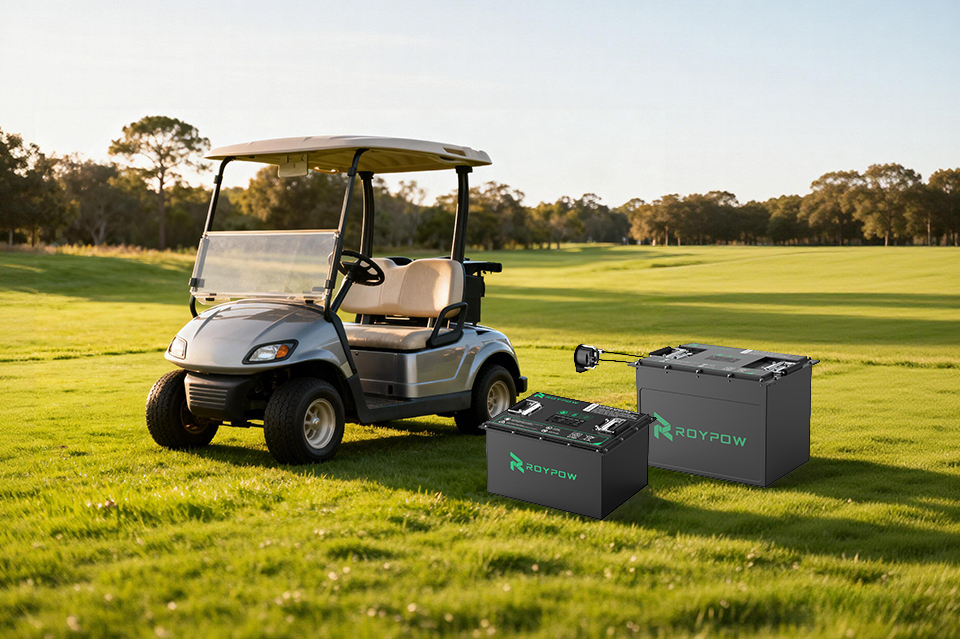
Fast Answer: EZGO TXT Lithium Conversion in Brief

An EZGO TXT lithium battery conversion replaces the cart’s original flooded lead-acid or AGM battery pack with a modern lithium iron phosphate, or LiFePO4, system. For most EZGO TXT golf carts, the upgrade delivers lower weight, faster charging, longer cycle life, stronger voltage stability, and far less maintenance. A typical conversion includes lithium batteries, a battery management system, mounting hardware, a compatible charger, main cables, a state-of-charge display, and sometimes a DC-DC converter for accessories.
For owners in golf communities, resorts, campuses, industrial sites, ports, theme parks, gated neighborhoods, farms, and city mobility fleets across the global world, the conversion is popular because it reduces downtime and operating cost. Instead of checking water levels, cleaning acid corrosion, and replacing lead-acid packs every few years, users can run a sealed lithium system designed for many more charge cycles. The result is a cleaner, lighter, and more predictable energy source.
The correct conversion depends on your TXT model year, whether the cart is 36V or 48V, the controller type, motor condition, accessory load, intended range, terrain, and local service availability. A carefully matched system from a proven lithium specialist can be a drop-in-ready upgrade, while a poorly matched kit may cause charger errors, underpowered acceleration, BMS cutoffs, or wiring issues.
For most standard TXT carts used on golf courses, resorts, marinas, and neighborhoods, a 36V or 48V LiFePO4 pack is the practical choice. Higher-voltage systems may be attractive for custom performance builds, but they require careful review of controller, motor, solenoid, wiring, braking, and safety components. Owners should choose certified batteries, a correct Golf Cart Battery Charger, and a supplier with real technical support.
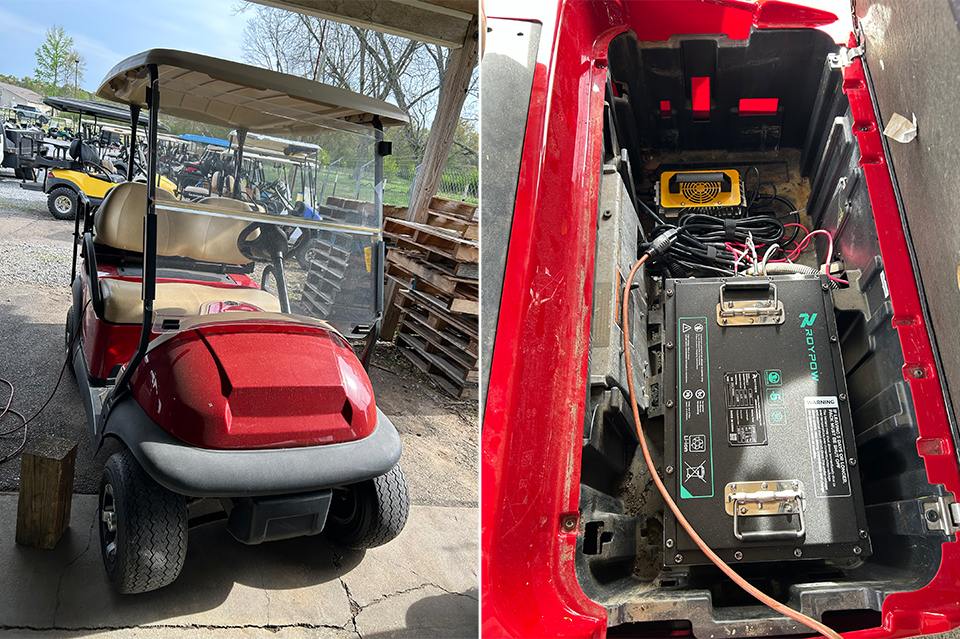
Understanding an EZGO TXT Lithium Battery Upgrade

An EZGO TXT lithium battery conversion is not merely a battery swap. It is the process of changing the cart’s energy storage architecture from lead-acid chemistry to lithium-ion chemistry, most commonly LiFePO4. The conversion affects weight distribution, charge behavior, discharge stability, range planning, onboard accessories, and maintenance routines. Because the TXT platform has been produced in many versions over several decades, the right approach starts with identifying the cart accurately.
The EZGO TXT is widely used in golf, hospitality, education, residential communities, maintenance operations, airports, factories, ports, and leisure transport. You can see TXT carts moving guests at resorts in Dubai and Bali, carrying tools around campuses in California and Queensland, transporting maintenance teams in Singapore logistics zones, and operating in golf communities near London, Johannesburg, Miami, São Paulo, and Seoul. This broad use makes the TXT one of the most common platforms for lithium conversion worldwide.
Lead-acid batteries have served the golf cart industry for many years, but they are heavy, require watering, lose voltage noticeably under load, and are sensitive to partial-state operation if not maintained correctly. Lithium batteries, especially LiFePO4, offer high usable capacity, stable voltage, and far longer cycle life. They also reduce total vehicle weight, which can improve acceleration, hill climbing, tire wear, and energy consumption.
A well-designed lithium conversion usually includes an integrated BMS. The BMS monitors cell voltage, pack voltage, current, temperature, and protection events. It can prevent overcharge, over-discharge, overcurrent, short circuits, and operation outside safe temperature limits. This electronic protection is one of the major differences between a quality lithium system and a simple group of battery modules.
From a user perspective, the upgrade changes everyday operation. Charging becomes shorter and more flexible. There is no need to water cells. Acid leaks and terminal corrosion are reduced. The cart can often travel longer on a single charge because the lithium system maintains voltage and uses capacity efficiently. For fleet managers, these improvements can reduce labor hours and simplify maintenance schedules.
However, the conversion must be done with respect for electrical compatibility. Some TXT carts are 36V, while others are 48V. Some are older series-drive systems, and others use different controllers. Accessories such as lights, radios, USB ports, coolers, GPS units, sprayers, and jobsite tools may require 12V power through a DC-DC converter. Chargers designed for lead-acid batteries should not be used unless specifically approved for the lithium battery profile.
In 2026, global demand for lithium conversions is being shaped by sustainability goals, rising labor costs, stricter facility safety policies, and the growth of electric low-speed vehicles. Golf course managers, resort operators, warehouse teams, and residential fleet owners increasingly look for systems that reduce emissions, simplify charging, and support digital monitoring. This is why the EZGO TXT lithium conversion has moved from a niche modification to a mainstream fleet upgrade.
What Comes in a TXT Lithium Conversion Package

A complete TXT lithium conversion kit should contain more than the battery itself. The most reliable kits are designed as an integrated power system, meaning the battery, charger, BMS, cables, display, brackets, and accessory power components are selected to work together. This reduces installation risk and improves long-term performance.
The central component is the LiFePO4 battery pack. Some kits use one large battery module, while others use several smaller modules connected in parallel or series to reach the target voltage and capacity. A single-pack solution can simplify wiring and reduce connection points. Modular solutions may provide flexibility in tight battery bays or allow easier service in certain regions.
The BMS is either built into each battery module or integrated into the battery system. It should be matched to the cart’s expected discharge current, peak current, and charging current. If a cart has a high-performance controller, upgraded motor, large tires, steep hill use, or heavy passenger load, the BMS current rating becomes especially important.
A lithium-compatible charger is essential. Lithium batteries require a different charging profile than flooded lead-acid batteries. Using the wrong charger can lead to incomplete charging, communication faults, shortened battery life, or safety shutdowns. A purpose-built Golf Cart Battery Charger should match the battery voltage, current, and charging protocol.
Mounting parts are also important. Lead-acid batteries are usually installed as multiple heavy units, while lithium batteries may use a different footprint. A strong mounting tray, hold-down brackets, and vibration-resistant hardware help protect the battery in real-world conditions, whether the cart is driving across a golf course in Scotland, a resort path in Thailand, a farm lane in South Africa, or a warehouse yard in Mexico.
Many kits include a state-of-charge meter. Lead-acid meters often estimate capacity based on voltage curves that do not match lithium behavior. Lithium voltage remains stable for much of the discharge cycle, so a lithium-capable display or communication-based meter is preferred. Some advanced systems support Bluetooth, CAN communication, app monitoring, or fleet-level diagnostics.
A DC-DC converter may be needed when a 36V or 48V battery pack powers 12V accessories. Without a proper converter, users may be tempted to tap one battery or part of the pack, which creates imbalance and reliability problems. A converter provides stable 12V output for lights, horns, radios, fans, GPS units, sprayers, and phone charging ports.
| Kit Component | Purpose | Why It Matters |
|---|---|---|
| LiFePO4 battery pack | Stores and delivers traction power | Determines range, weight reduction, cycle life, and power stability |
| Battery management system | Monitors and protects the battery | Prevents unsafe operation and helps extend service life |
| Lithium charger | Charges with the correct profile | Avoids undercharging, overcharging, and charger mismatch problems |
| Main power cables | Connects pack to cart electrical system | Correct cable size reduces heat, voltage drop, and failure risk |
| Mounting tray or brackets | Secures battery in the compartment | Protects the pack from vibration, impact, and movement |
| State-of-charge display | Shows remaining battery capacity | Helps users plan range more accurately than a lead-acid meter |
| DC-DC converter | Provides 12V accessory power | Prevents unbalanced battery tapping and supports accessories safely |
| Installation guide | Explains wiring and setup | Reduces installation errors and supports safe commissioning |
This table shows why buying only the cheapest battery can be risky. A conversion system is a chain, and the weakest part affects the whole cart. For example, a high-quality battery connected with undersized cables or charged by an incorrect charger will not deliver its full potential. Similarly, an excellent charger cannot compensate for a poorly protected battery pack.
When comparing products, buyers should check certifications, warranty terms, cycle-life claims, battery chemistry, peak current rating, support documentation, and availability of replacement parts. For common TXT upgrades, ROYPOW provides lithium solutions for multiple voltage platforms, including 36V Golf Cart Batteries and 48V Golf Cart Batteries, designed for practical golf cart applications.
EZGO TXT Model-Year and System Compatibility Guide
Compatibility is the foundation of a successful conversion. Before selecting any lithium pack, identify the cart’s model year, voltage, drive system, controller, motor type, charger port, accessories, and battery bay dimensions. TXT models have evolved, and the wiring layout may differ between early 36V carts, later 48V carts, fleet golf carts, personal transportation vehicles, and modified custom units.
One of the first steps is to confirm whether your TXT is 36V or 48V. Older TXT carts are often 36V, typically using six 6V lead-acid batteries. Many newer TXT versions use 48V systems, often with six 8V or four 12V lead-acid batteries. However, previous owners may have modified the cart, so do not rely only on model year assumptions. Check the existing battery arrangement, controller label, solenoid rating, motor markings, and service documentation.
The table below provides a general reference for common TXT compatibility considerations. It is not a substitute for inspecting the actual cart, but it helps owners and dealers plan the conversion conversation.
| TXT Category | Typical Voltage | Common Battery Layout | Lithium Conversion Notes |
|---|---|---|---|
| Older TXT fleet carts | 36V | Six 6V lead-acid batteries | Often suitable for 36V lithium if controller and wiring are healthy |
| TXT personal transport models | 36V or 48V | Varies by year and configuration | Confirm actual voltage before selecting the kit |
| Later TXT 48V carts | 48V | Six 8V or four 12V lead-acid batteries | Typically converted with a 48V LiFePO4 system |
| Modified TXT with upgraded controller | 36V, 48V, or custom | Depends on previous upgrades | Check peak current demand and BMS discharge rating carefully |
| Lifted TXT with large tires | 36V or 48V | Varies | Higher load may require greater amp-hour capacity and current rating |
| Utility TXT with cargo box | 36V or 48V | Varies | Consider payload, hills, duty cycle, and accessory power |
| Resort or campus fleet TXT | Often 48V | Fleet-specific configuration | Fleet charging logistics and service support are key |
| Custom high-performance TXT | 48V or higher | Custom | May require controller, solenoid, cable, brake, and motor review |
The table highlights a critical point: model year matters, but actual configuration matters more. A 36V TXT may have been converted to 48V by a previous owner. A fleet cart may have different accessory wiring than a personal cart. A lifted vehicle in a hilly area near Cape Town or San Francisco may draw more current than a stock cart on flat resort paths in the Maldives or the Netherlands.
Battery compartment measurements are another compatibility factor. Lithium packs are usually lighter and may be smaller than the lead-acid batteries they replace, but not every battery shape fits every tray. Measure length, width, height, clearance above terminals, cable routing space, and bracket positions. Confirm that the pack can be secured firmly and that no metal edge can rub against the case or cables.
Charger compatibility also varies. Some carts use an external charger with a specific plug, while others may have onboard charging arrangements. You need to ensure the charging port, receptacle, charger output, and battery requirements match. If you are buying from a local dealer in Los Angeles, Rotterdam, Hamburg, Durban, Sydney, Osaka, Dubai, or São Paulo, ask whether they provide the correct charger plug and after-sales support for your market.
For many owners, a supplier offering dedicated golf cart systems simplifies the decision. ROYPOW’s Golf Cart Batteries are designed around lithium iron phosphate technology and are intended as replacements for lead-acid systems in golf cart applications. In some regions, buyers may also source suitable Golf Cart Battery options through specialized battery retailers, provided compatibility and support are verified.
Step-by-Step Process to Convert a TXT from Lead-Acid to Lithium
Converting an EZGO TXT from lead-acid to lithium should be done methodically. If you are not comfortable working with high-current DC electrical systems, hire a qualified golf cart technician. Batteries can deliver dangerous current, and incorrect wiring may damage the cart or cause injury. Always follow the instructions provided by the battery manufacturer and the cart service manual.
Step 1: Identify the cart. Record the serial number, model year, voltage, controller rating, motor type, solenoid rating, charger type, and existing battery configuration. Photograph the battery bay before disconnecting anything. Label major cables and note where the main positive and main negative leads connect.
Step 2: Define the use case. Decide how the cart will be used. A golf course fleet cart that runs two rounds per day has different needs from a neighborhood cart used for short evening trips. A resort shuttle in Phuket, a marina cart in Miami, a vineyard cart in France, and a maintenance cart at a logistics hub near Singapore may all need different range and current ratings.
Step 3: Select the correct lithium system. Choose voltage, capacity, peak discharge rating, charger, mounting kit, display, and DC-DC converter. If the cart is a standard 36V TXT, review 36 Volt Lithium Golf Cart Batteries. If it is a 48V TXT, compare 48 Volt Lithium Golf Cart Batteries. Do not select a battery only by amp-hour rating; current output and BMS protection are equally important.
Step 4: Prepare the work area. Park on level ground, turn the key off, place the direction selector in neutral or tow/maintenance mode if applicable, engage the parking brake, remove jewelry, wear eye protection, and use insulated tools. Keep sparks, flames, and metal objects away from the battery bay.
Step 5: Disconnect the lead-acid pack. Disconnect the main negative cable first, then the main positive cable, and then remove interconnect cables. Lead-acid batteries are heavy, so use proper lifting equipment. Avoid tipping flooded batteries because acid can spill. Dispose of old batteries through an approved recycling channel.
Step 6: Clean and inspect the battery compartment. Neutralize any acid residue according to safe procedures, remove corrosion, inspect the tray for rust or cracks, and check cable insulation. Replace damaged cables, loose terminals, worn solenoids, or questionable connectors before installing the lithium system.
Step 7: Install mounting hardware. Fit the tray, brackets, or spacers required by the lithium kit. The battery must not move during acceleration, braking, cornering, or transport. In fleet operations, vibration and repeated daily use can loosen poor installations quickly.
Step 8: Place and secure the lithium battery. Lower the battery into position, keeping terminals protected from accidental contact. Tighten hold-downs to the recommended torque. Do not drill into a battery case or modify the enclosure. Keep cables away from sharp edges, moving parts, and hot components.
Step 9: Connect power cables. Follow the wiring diagram exactly. Use correct polarity, cable gauge, fuse or breaker requirements, and terminal torque. Many lithium systems use a main positive, main negative, charger leads, communication leads, and sometimes display or wake-up wiring. Incorrect polarity can destroy components instantly.
Step 10: Install the charger connection and display. Connect the lithium charger port or onboard charger as instructed. Install the state-of-charge display where the driver can see it. If using app-based monitoring, pair the system and verify readings before operation.
Step 11: Install a DC-DC converter for accessories. If the cart uses 12V accessories, connect them through a properly rated converter. Avoid tapping part of the lithium pack. Confirm accessory current draw, fuse protection, and grounding method.
Step 12: Commission the system. Before driving, check voltage, display readings, charger operation, cable tightness, and absence of fault codes. Perform a short low-speed test in an open area. Listen for abnormal sounds, feel for heat at terminals after a short run, and confirm acceleration and braking are normal.
Step 13: Train users. Fleet drivers and private owners should understand charging habits, state-of-charge reading, storage procedures, and fault indicators. Lithium systems are low-maintenance, but they are not maintenance-free in the sense of ignoring all inspection. Periodic cable checks and charger checks remain important.
| Installation Stage | Key Check | Common Tool or Action |
|---|---|---|
| Cart identification | Voltage, model, controller, motor | Serial number lookup and visual inspection |
| Battery removal | Safe disconnection order | Insulated wrench and battery lifting method |
| Compartment preparation | Corrosion, tray condition, cable condition | Cleaning, inspection, and replacement parts |
| Battery mounting | Secure fit and vibration control | Tray, brackets, straps, and torque check |
| Electrical connection | Polarity, cable gauge, fuse protection | Wiring diagram and torque wrench |
| Accessory integration | 12V supply and fuse sizing | DC-DC converter and distribution wiring |
| Charging setup | Correct lithium charging profile | Compatible charger and receptacle check |
| Commissioning | Voltage, display, faults, short road test | Multimeter, app, and controlled test drive |
This staged approach is especially useful for local suppliers and fleet workshops. It creates a repeatable process, reduces warranty disputes, and helps technicians document each conversion. In larger operations such as golf resorts in Spain, retirement communities in Florida, university campuses in Australia, and port maintenance fleets in the United Arab Emirates, documentation is essential because many carts may be converted over a short period.
36V and 48V TXT Conversions: Main Differences
The difference between 36V and 48V TXT lithium conversion is more than a number on the battery label. Voltage affects current draw, controller compatibility, charging equipment, performance feel, and upgrade path. The right choice is usually to match the cart’s original system voltage unless you are intentionally rebuilding the powertrain with compatible components.
A 36V lithium conversion is common for older TXT carts that originally used six 6V batteries. It can provide a major improvement in weight reduction, voltage stability, and maintenance reduction without requiring a full electrical redesign. For stock carts used on moderate terrain, a 36V lithium pack can be a practical and cost-effective path.
A 48V lithium conversion is common for later TXT carts and for owners who want stronger performance within a widely supported voltage platform. A 48V system can deliver the same power with lower current than a 36V system, which may reduce stress on cables and connectors when correctly designed. It is also a common choice for golf courses and personal transportation vehicles that need better hill climbing or longer daily use.
Converting a 36V cart to 48V is possible in some cases, but it is not the same as installing a 36V lithium replacement. A voltage upgrade may require a compatible controller, solenoid, motor evaluation, forward/reverse components, charger, DC-DC converter, cables, and sometimes speed sensor considerations. Owners should not assume the original components can tolerate higher voltage.
Capacity planning is also important. Amp-hours are not directly comparable across different voltages without considering watt-hours. A 36V 100Ah pack stores about 3.6kWh nominal energy, while a 48V 100Ah pack stores about 4.8kWh nominal energy. Real-world range then depends on terrain, speed, tire size, load, wind, temperature, and driving style.
| Factor | 36V TXT Lithium Conversion | 48V TXT Lithium Conversion |
|---|---|---|
| Typical cart match | Older TXT models originally built as 36V | Later TXT models and many personal transport carts |
| Installation complexity | Usually simpler when replacing a 36V pack | Simple if cart is already 48V; complex if upgrading from 36V |
| Performance feel | Good stability and weight reduction | Often stronger acceleration and hill performance |
| Current demand | Higher current for the same power level | Lower current for the same power level |
| Charger requirement | 36V lithium charger | 48V lithium charger |
| Accessory power | Requires suitable DC-DC converter for 12V loads | Also requires suitable DC-DC converter for 12V loads |
| Best use case | Standard golf, neighborhood, light-duty use | Fleet, hillier terrain, longer routes, heavier daily use |
| Upgrade caution | Avoid under-rated BMS on high-load carts | Confirm controller and motor compatibility if changing voltage |
The comparison shows that 48V is not automatically “better” for every owner. The best system is the one matched to the cart and duty cycle. A stock 36V cart used on flat paths in a residential community may be perfectly served by a quality 36V lithium pack. A heavily used resort cart in hilly terrain may benefit from a 48V platform if the cart is already designed for it or properly upgraded.
There are also higher-voltage golf cart systems for specialized applications. For certain modern carts and performance builds, 72V Golf Cart Batteries may be relevant, but they are not a casual replacement for a standard TXT without engineering review. Higher voltage can support advanced performance, but it also increases the importance of component matching and safety discipline.
Performance Improvements You Can Expect After Lithium Conversion
The most immediate performance improvement is weight reduction. A set of lead-acid batteries can weigh hundreds of pounds, while a comparable lithium system is often much lighter. Less weight means the cart requires less energy to move, especially during acceleration and hill climbing. Drivers often notice a more responsive feel after conversion.
Another improvement is voltage stability. Lead-acid voltage drops significantly under load and declines as the pack discharges. Lithium maintains a flatter voltage curve, so the cart can feel more consistent across the discharge cycle. Instead of feeling strong after a fresh charge and sluggish later, the cart maintains performance for much longer.
Charging speed is also a major benefit. Many lithium systems recharge faster than lead-acid packs, and they do not require the same lengthy absorption and equalization routines. This is valuable for golf courses that need carts ready between tee times, resorts with round-the-clock guest transport, and industrial sites where utility carts must return to service quickly.
Maintenance reduction may be the most valuable performance gain for fleet owners. Lead-acid batteries require watering, cleaning, terminal maintenance, and careful charging management. Lithium systems eliminate watering and reduce corrosion problems. Maintenance staff can focus on tires, brakes, steering, suspension, and cleaning rather than battery acid and hydrometer readings.
Range can improve, but it must be understood correctly. A lithium pack with similar nominal capacity may provide more usable energy because it can be discharged more deeply and maintains voltage better. However, if you install a very small lithium pack to save money, range may not improve. Buyers should calculate their real daily route distance and add reserve capacity.
Performance also depends on the rest of the cart. A worn motor, dragging brake, underinflated tires, bad wheel bearings, poor alignment, or corroded cables can limit the benefit of lithium. A conversion is a good time to inspect the entire vehicle, especially if it is used commercially.
The global market is also shifting toward smarter batteries. In 2026, trends include app-based monitoring, CAN communication, integrated telematics, remote diagnostics, improved thermal protection, more standardized battery trays, and better charger communication. Policies in many regions are also pushing cleaner transport for campuses, resorts, municipalities, and indoor industrial sites. Sustainability reporting may encourage fleet managers to document reduced maintenance waste, energy efficiency, and battery recycling pathways.
| Performance Area | Typical Lead-Acid TXT | After Quality Lithium Conversion |
|---|---|---|
| Vehicle weight | Heavy battery pack increases load | Lower weight improves efficiency and handling |
| Acceleration | Can feel sluggish as voltage sags | More consistent response through the charge cycle |
| Hill climbing | Performance drops with low state of charge | Stable voltage supports steadier climbing |
| Charging time | Often longer with lead-acid charge stages | Usually faster with proper lithium charger |
| Maintenance | Watering, cleaning, corrosion control | No watering and reduced terminal corrosion |
| Usable capacity | Limited by depth-of-discharge concerns | Higher practical usability when sized correctly |
| Storage behavior | Requires frequent maintenance charging | Lower self-discharge with correct storage procedures |
| Fleet uptime | Downtime for watering and battery service | More time available for operation |
The table explains why lithium conversion is attractive beyond speed. For many operators, uptime, predictable range, and lower labor demand are more important than top speed. A golf club in Ireland, a university in Canada, a port maintenance depot in Singapore, and a resort in the Caribbean may all value different benefits, but the underlying improvement is the same: the energy system becomes cleaner, lighter, and easier to manage.
Installation Errors That TXT Owners Should Avoid
The most common mistake is choosing the wrong voltage. Installing a 48V battery in a cart designed only for 36V components can damage electronics and create unsafe conditions. Similarly, installing a 36V lithium pack in a 48V cart will not deliver the required system voltage. Always confirm the actual cart voltage before ordering.
Another frequent mistake is using the old lead-acid charger. Even if the plug fits, the charging profile may be wrong. Lithium systems need a charger matched to the battery chemistry and voltage. Some modern systems use communication between the battery and charger, and a mismatched charger can trigger faults or reduce performance.
Undersized cables are also a problem. Lithium batteries can deliver strong current, and high-load carts may demand significant peak power. If cables are too small, old, corroded, or poorly crimped, they can heat up and waste energy. Terminals should be clean, properly torqued, and protected from accidental short circuits.
Ignoring accessory loads can create hidden problems. Many TXT carts have lights, sound systems, USB chargers, fans, GPS units, coolers, sprayers, or work lights. These accessories need reliable 12V power. Tapping a portion of the pack is not a good solution because it can create imbalance. A properly rated DC-DC converter is the preferred method.
Some owners focus only on amp-hours and ignore BMS current rating. A high amp-hour battery with a low discharge limit may still shut down under steep hills, heavy passengers, lifted tires, or aggressive acceleration. Current rating should match the cart’s controller and duty cycle.
Poor mounting is another avoidable issue. Because lithium batteries are lighter, some installers assume they do not need strong restraint. In reality, any battery must be secured against vibration, impact, and movement. A loose battery can damage cables, terminals, or the enclosure.
Failure to inspect the cart before conversion can also lead to disappointment. A lithium battery will not fix mechanical drag, weak brakes, worn suspension, bad alignment, or a failing controller. A pre-conversion inspection helps separate battery problems from vehicle problems.
Finally, buying from an unknown source with no technical support can create long-term risk. Local suppliers matter in the global world because warranty handling, charger replacement, installation guidance, and parts availability depend on regional support. Buyers near major trade hubs such as Los Angeles, Hamburg, Rotterdam, Dubai, Singapore, Busan, Sydney, Durban, and Santos should ask about dealer coverage, service response, and documentation before purchasing.
About ROYPOW and Our Lithium Capabilities
ROYPOW TECHNOLOGY focuses exclusively on lithium battery systems and energy storage solutions. For golf cart owners, fleet operators, and dealers, this specialization matters because lithium replacement is not a side business; it is the core technical direction. The company develops LiFePO4 solutions for motive power and energy storage applications, including golf carts, forklifts, aerial work platforms, floor cleaning machines, scissor lifts, trolling motors, industrial vehicles, residential energy storage, commercial energy storage, marine systems, RV electrical systems, and truck auxiliary power units.
Technological capabilities. ROYPOW maintains in-house research and development across battery management systems, battery pack design, system engineering, industrial design, inverter design, and software development. This integrated approach helps ensure that the battery, BMS, charger, monitoring functions, and safety protections are designed as a complete system. For an EZGO TXT lithium conversion, these capabilities help address real operating needs such as current output, temperature protection, charger matching, and state-of-charge accuracy.
The company’s testing resources include a large dedicated testing center equipped for battery cell testing, system testing, BMS testing, charger testing, energy storage testing, and hybrid inverter testing. Rigorous testing is important because golf carts work in varied climates and duty cycles: hot resort paths in the Middle East, humid coastal courses in Southeast Asia, cold mornings in Northern Europe, dusty estate roads in Africa, and busy fleet routes in North America.
Manufacturing capabilities. ROYPOW has more than 20 years of experience in new energy solutions and operates manufacturing bases in China and Indonesia, supported by a large headquarters, advanced production systems, automatic production lines, and quality management practices including IATF16949 certification. Vertical integration supports consistent production quality and allows better coordination between design, manufacturing, testing, and after-sales service.
This manufacturing strength is important for global supply. Golf cart battery demand is not limited to one region. Dealers and fleet customers require dependable delivery into North America, Europe, Asia-Pacific, the Middle East, Africa, and Latin America. Regional logistics often move through major ports and trade hubs such as Shanghai, Ningbo, Singapore, Rotterdam, Hamburg, Los Angeles, Long Beach, Jebel Ali, Busan, Yokohama, Sydney, Durban, and Santos. A manufacturer with broad operations and dealer support can better serve global customers with consistent products.
Service capabilities. ROYPOW supports customers through subsidiaries and regional teams in multiple markets, including the United States, Brazil, the United Kingdom, Germany, the Netherlands, South Africa, Iraq, Australia, Japan, and Korea. The service commitment emphasizes quick response and fast resolution. For installers and fleet operators, this means technical guidance, warranty support, product documentation, and after-sales service are part of the value proposition.
For golf cart applications, ROYPOW offers a range of lithium solutions across 36V, 48V, and 72V platforms. Buyers evaluating an EZGO TXT conversion can review the broader Golf Cart Battery lineup to compare voltage options, charger compatibility, and system features. The goal is not simply to replace lead-acid batteries, but to improve the entire ownership experience through efficiency, reliability, and lower maintenance.
As sustainability expectations rise in 2026, lithium conversions also support cleaner electric mobility. Resorts, golf clubs, municipalities, schools, ports, warehouses, and industrial parks increasingly prefer quiet, low-emission transport. While responsible battery recycling and supply-chain management remain important, long-cycle LiFePO4 systems can reduce frequent battery replacement and support the broader transition from fossil fuel and high-maintenance legacy systems toward electrified operations.
Frequently Asked Questions About EZGO TXT Lithium Conversion
Can I convert any EZGO TXT to lithium?
Most electric EZGO TXT carts can be converted to lithium, but the correct kit depends on voltage, model year, controller, motor, battery bay size, and accessory wiring. Always inspect the actual cart before buying.
Should I choose 36V or 48V lithium for my TXT?
Match the cart’s original system unless you are planning a full voltage upgrade. A 36V TXT usually needs a 36V lithium system, while a 48V TXT usually needs a 48V lithium system.
Can I use my old lead-acid charger with lithium batteries?
Usually no. Lithium batteries need a compatible lithium charging profile. Use the charger recommended by the battery manufacturer to protect performance, safety, and warranty coverage.
How much range will I gain after conversion?
Range depends on battery capacity, terrain, speed, tire size, passenger load, accessory use, and driving style. A properly sized lithium pack often provides more usable energy and more consistent performance than lead-acid.
Does lithium make an EZGO TXT faster?
Lithium may improve acceleration and consistency because of lower weight and better voltage stability. Top speed is usually controlled by the motor, controller, gearing, tires, and cart programming, not only the battery.
Do I need a DC-DC converter?
If your cart has 12V accessories, a DC-DC converter is strongly recommended. It provides stable accessory power and avoids unsafe or unbalanced tapping from the battery pack.
Is LiFePO4 safe for golf carts?
LiFePO4 is widely used in golf cart applications because it offers strong thermal stability, long cycle life, and good safety characteristics when paired with a quality BMS and correct charger.
How long does installation take?
A straightforward conversion may take a trained technician a few hours. Complex carts with corrosion, accessory wiring, custom controllers, or voltage upgrades can take longer.
What maintenance is required after conversion?
Lithium batteries do not need watering. However, you should periodically inspect cables, terminals, mounting hardware, charger operation, and state-of-charge readings.
Can a lifted TXT use lithium?
Yes, but lifted carts with large tires and heavy loads may draw more current. Choose a battery with sufficient capacity and BMS discharge rating for the higher demand.
What happens to the old lead-acid batteries?
They should be recycled through an approved battery recycling channel. Lead-acid recycling is widely available in many global markets, and proper disposal protects the environment.
Is a single lithium battery better than multiple modules?
A single pack can simplify wiring, while modular systems may offer flexibility. The better choice depends on battery bay space, service strategy, current rating, and supplier design.
Can lithium conversion help fleet operators?
Yes. Fleets often benefit from faster charging, reduced maintenance labor, less downtime, improved energy efficiency, and more predictable daily operation.
Where can I buy lithium batteries for an EZGO TXT?
Buy from a qualified manufacturer, authorized dealer, or specialized battery supplier that can confirm compatibility, provide a proper charger, and support warranty service in your region.
What is the biggest mistake to avoid?
The biggest mistake is buying only by price without checking voltage, BMS current rating, charger compatibility, mounting, accessory power, certifications, and after-sales support.